Writing a novel in Slima
You are on chapter thirty. Something has to remember chapter six.

The hard part of a long book was never getting words down. It is being ninety thousand words in and still able to say who is where, who promised what, and what colour her eyes were.
Why it is hard

You are not being careless. This is what a year does to memory.

Spend a year on one book and your grip on the early chapters loosens. That is not a flaw in you, it is how memory works. The flaw is that most writing tools leave you to cover the gap on your own.

🧠

You remember what you wrote last

The setup in chapter six went in three months ago. You did not forget it. It is simply a long way from where you are now.

🗂️

Your tool broke the book up and never put it back

Most apps hand you folders and chapters. Nothing in them has read the whole thing, and the character notes are in a different app anyway.

↩️

One big revision and there is no way back

You want to move the structure, but the current draft is the only draft. So you leave it, and the book sits there for another month.

How Slima handles it

Let the book keep its own memory.

📚

The coach has read every chapter

Ask whether she would really say that here, and the answer comes out of your book rather than a guess based on the last page you had open.

Contradictions surface before a reader finds them

A continuity check reads chapters against each other. An eye colour that changed, a job that changed, a date that will not add up. It tells you where.

🕸️

The story bible lives in the same tree

Relationship board, world map, story timeline, beat board. Six file types sit beside the chapters, and the AI can read all six.

Every save is somewhere you can return to

Version history is on the free plan, and a snapshot goes in before the AI touches anything. Restore a single file without rolling the whole book back.

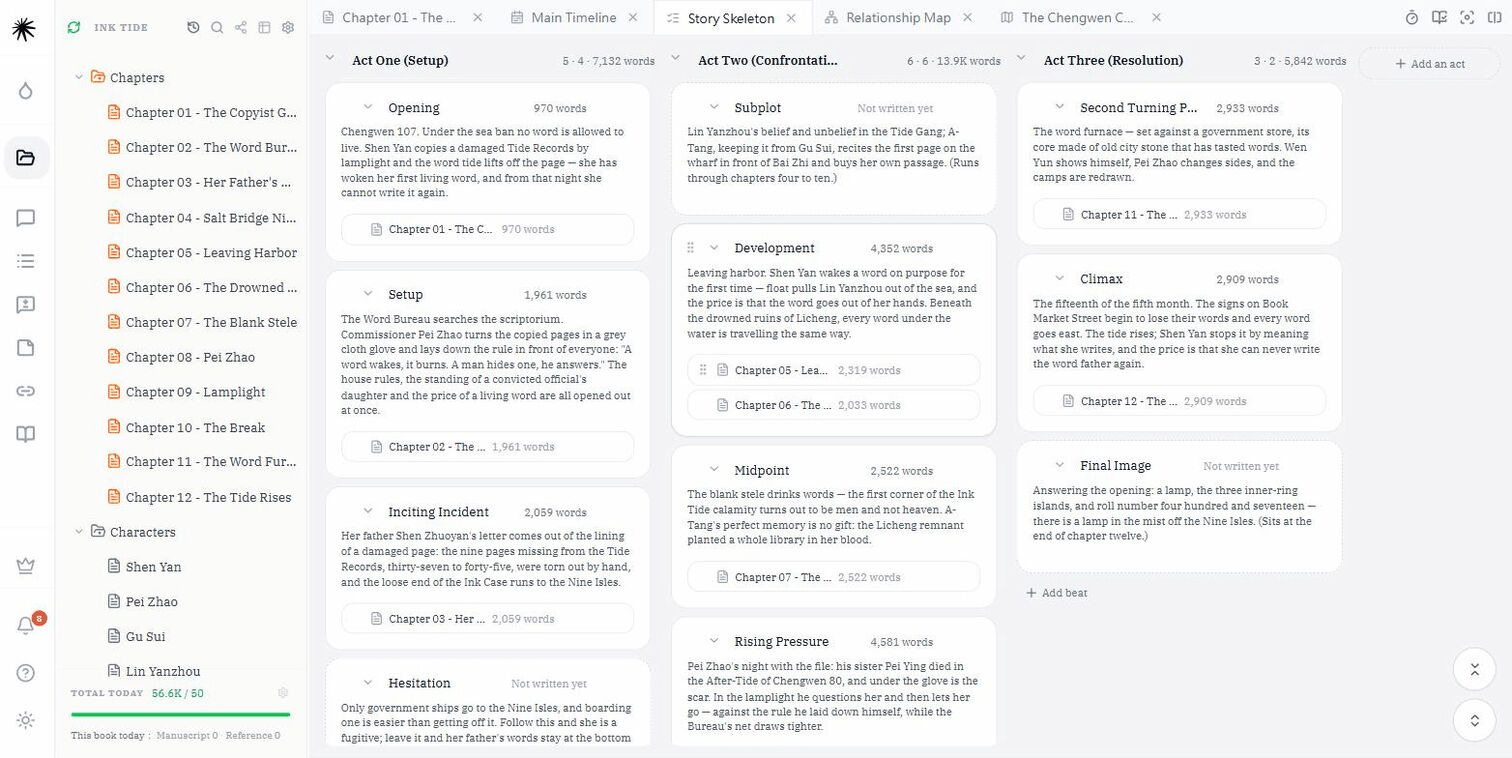
Beat board: three acts as three columns, each beat card followed by the chapter it maps to and that chapter's word count.
The Story Skeleton for Ink Tide. Every card links to a real chapter, so a sagging second act stops being a suspicion and becomes something you can see.
Querying and self-publishing

Two roads out, and they break the same book differently.

A query package lives or dies on the first fifty pages and a synopsis that holds together, so a soft opening is fatal and a soft middle can hide for a while. Self-publishing runs the other way round. The people who bought book one will tell you exactly which chapter they put it down in, and they will say so in public. Same manuscript, two different failure modes.

The AI beta reader's attention curve is aimed at the second one. It marks the chapter where readers drift, which is usually the chapter an agent stops on as well.

The first chapter costs nothing.

One book, full-project memory and version history on the free plan. Write for an afternoon and see whether it holds on to your details.