Writing a series in Slima

Twelve episodes. One project.
Each episode is a file in the tree. The series bible, the beats for the whole season and the map of the city it happens in are sitting right next to it.
Each episode is a file in the tree. The series bible, the beats for the whole season and the map of the city it happens in are sitting right next to it.
Twelve episodes ask you to hold one more dimension than a novel does: who turns up in which episode, where each thread lands, and how many minutes this one actually runs.
The trait you establish in episode three has to cost her something in episode nine. Six episodes sit in between, and memory does not bridge that.
You write it, you format it, and only then does it turn out to run eight minutes long.
Change the layout and you reformat the whole thing. The layout a production company wants is not always the one you write in.
Right-click, new screenplay, one per episode. It has real scenes and real elements, not a text file doing an impression of a screenplay.
Acts are columns and beats are cards, and a card can hold the episode it turned into. When the shape changes, drag the beat into another act.
Who speaks in a scene is read from the scene, so rewriting a line updates it. Characters you added by hand survive the rewrite.
Format is a property of the file. Set it once and every export follows the same rules, in PDF or Word, in local or Hollywood layout.
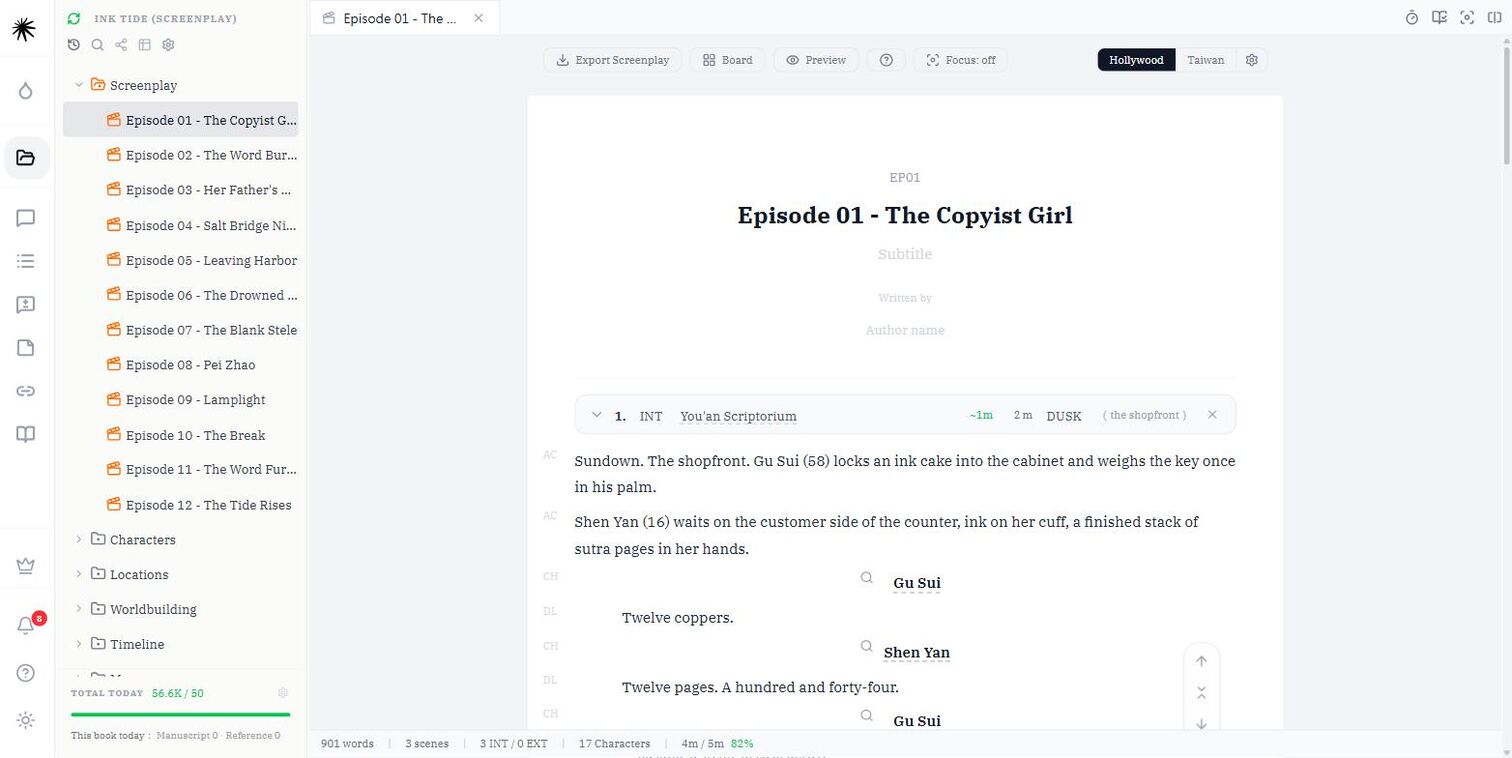
A spec is a reading sample before it is anything else, and whoever opens it is looking at page count, at a runtime that fits the slot, and at a layout that does not make them work. What nobody is looking at is your project file. Slima gives a screenplay two layouts: a local numbered-slug layout and standard Hollywood. There is no third national standard in here, and we would rather say so now than at the export dialog.
Export a whole season at once and you get one merged PDF with a title page, or a zip of Word files, one per episode.
Open a book, add a screenplay file, put a slug line in it. That is the entire test.
Before we count anything
Analytics and advertising cookies stay off until you turn them on. The ones that keep the site working, and the one that remembers this choice, are always on. The detail is in the Privacy Policy.